How Offices Can Encourage Creativity
 Every company wants their office to be a place that inspires employees. But what sort of elements can you use that will spark that creative flame? There are several ways to give your office a makeover. Check out some of the things that successful companies have done to tap into their employees’ creativity.
Walls Should Be Idea Spaces
Nowadays, walls aren’t just something you use to enclose workers in a corporate bubble. Their sources for creativity. Reebok has a room where employees can brainstorm the company’s latest designs by writing on the walls. Someone will draw out their suggestion, and co-workers will then make their own changes or suggestions to the design. Because of this collaborative approach, the design is ready for final approval by the end of the week.
Likewise, DoSomething.org has cork walls where employees can pin images for future ideas, just like a real-world version of Pinterest. Besides these ideas, other wall decorations include letters from past customers and examples of similar products. As CEO Nancy Lublin says, their wall décor includes “examples of ‘inspiration’ and ‘perspiration.’”
Have a Bold Lobby
DoSomething.org’s lobby wall holds a message with the company logo and a message stating, “Because apathy sucks.” If you want to show your visitors what you do, make sure that they know the minute they walk through the door. Quips Lubin, “If you fill [your lobby] with random magazines, plants, and leather couches...I hope you sell random magazines, plants and leather couches.” As a bonus, seeing this sort of mission statement can also serve as an inspiring message to employees, reminding them every day of what the company’s goals are.
Common Areas
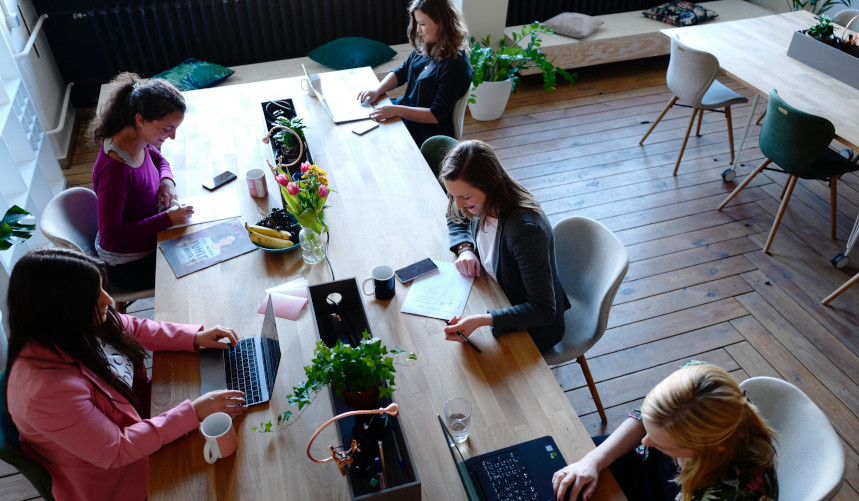
Another unusual quirk of DoSomething.org? Its office has no cubicles or desks. Instead, employees sit at IKEA tables and rotate on a periodic basis. Lublin says the benefit of this is that employees from different departments get to interact and learn about one another.
Because of privacy concerns and safety issues, it may not be ideal to convert your office into this kind of open layout. But there is still a lesson you can apply to your own workplace. Having a common space can be good for office morale, camaraderie, and productivity. In light of that, many offices are now using communal spaces such as libraries and cafes to make for a more collaborative and enjoyable atmosphere. Planning for the same in your office building may do your team a world of good.
Have All 5 C’s In Place
IdeaPaint employee Amanda Schneider says that a successful office will account for the following things:
1.) Comfortable spaces—This means supportive and comfortable furniture, a pleasing color scheme, and open spaces. Essentially, it’s making your office into a place where employees enjoy spending their time.
2.) Communal Spots— Steve Jobs designed Apple’s headquarters so that his employees could freely talk among themselves. Which just goes to show you: Gathering areas where employees can chat are valuable. These laid-back exchanges are often the source of the company’s best ideas.
3.) Connectivity—This one almost goes without saying, but your team wants to be able to connect to the Internet without any problems.
4.) Coffee—Pouring themselves a cup coffee while chatting with a co-worker can lead people to brainstorm some excellent ideas.
5.) Connection—Having a television set to a news channel can help employees feel less isolated from the rest of the world.
Creativity is often associated with freedom and openness, and you may feel tempted to let those two things into your office space. However, that doesn’t mean you should let your office be chaotic or unorganized. Once you’ve decided what creative touches you’ll use in your office, you may need an office management software to help you keep track of things. OpenOffice Software will be happy to help you with all your logistical needs, while also supporting your desire for an optimal creative space.
Image credit: freedigitalphotos.net/photostock
Related Posts
 Office Design
The 7 benefits of standing desks
 Office Design
How facilities management can influence office design

 Visual Directory
 Move Manager
 Space Management
 Reporting & Analytics
 Request Management
 Desk Booking
 Resource Tracking
 Technology
 Services & Support